
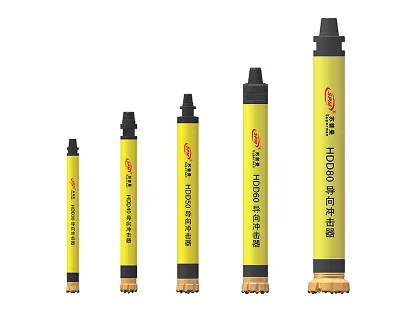
HDD Pilot Hammers
SPM HDD pilot hammers are used to establish the initial bore in hard-rock horizontal directional drilling. The hammer works at the bottom of the borehole, transferring percussive energy directly to the bit while the drill rig provides rotation and directional control.
The current range includes HDD30, HDD40, HDD50, HDD60 and HDD80, covering drilling diameters from 90 mm to 254 mm. Different hammer sizes use matched API REG top sub connections and air requirements for different pilot-hole diameters and drilling conditions.
HDD pilot hammers are designed for hard-rock pilot-hole drilling in trenchless crossings and directional bore construction. They can be used where underground pipelines, utilities and other infrastructure routes need to pass through hard or abrasive formations before the bore is enlarged to the required final diameter.
The hammer delivers high-frequency impact energy directly at the bit while the drill rig rotates the drill string. This combination fractures the rock at the bore face and reduces the rotational load required for rock breaking. SPM lists the HDD hammer range for use with standard directional drilling rigs using DCI, Subsite and U-Mag locator systems.
Select the hammer according to the required pilot-hole diameter, drill-string connection and available compressed-air supply. The table below shows the current HDD30-HDD80 range.
| Model | Drilling Diameter | Top Sub Thread | Hammer OD | Effective Length | Weight | Air Consumption |
|---|---|---|---|---|---|---|
| 90-105 mm | API 2 3/8 REG pin | 80 mm | 812 mm | 25 kg | 4.5 m³/min @ 10 bar 8.5 m³/min @ 17 bar | |
| 115-130 mm | API 2 3/8 REG pin | 98 mm | 986 mm | 39 kg | 5 m³/min @ 10 bar 9.5 m³/min @ 17 bar | |
| 140-152 mm | API 2 3/8 REG pin | 124 mm | 1094 mm | 70 kg | 7 m³/min @ 10 bar 13.5 m³/min @ 17 bar | |
| 165-194 mm | API 3 1/2 REG pin | 146 mm | 1240 mm | 108 kg | 9 m³/min @ 10 bar 17 m³/min @ 17 bar | |
| 203-254 mm | API 4 1/2 REG pin | 185 mm | 1346 mm | 193 kg | 13 m³/min @ 10 bar 24 m³/min @ 17 bar |
Start with the required pilot-hole diameter, then confirm the drill-string connection and the compressor output available at the drilling pressure. Rock hardness, abrasiveness and the directional drilling rig configuration should also be considered so that the hammer, bit and air supply operate as a matched system.