
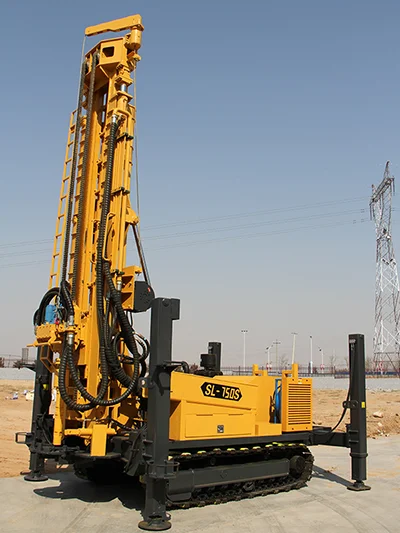


700 Series Water Well Drilling Rig
Well drilling equipment for drilling depths up to 750m with a borehole diameter range of 105-450mmThe SL700S/SL750S water well drilling rig is suitable for loose formations and bedrock.
It uses rotary drilling to deliver a maximum drilling depth of 750 m and a drilling diameter range of 105 to 450 mm.
The rig provides stable performance and high operational efficiency, supporting both hammer drilling and mud drilling.
It is equipped with a complete set of optional components and is suitable for a wide range of geological conditions.
Technical Parameters
| Parameter | Unit | SL700S | SL750S |
| Max. drilling depth | m | 700 | 750 |
| Drilling diameter | mm | 105-450 | 105-450 |
| Recommended air pressure | MPa | 1.6-6 | 1.6-6 |
| Recommended air consumption | m³/min | 16-75 | 16-75 |
| Drill pipe length | m | 6 | 6 |
| Recommended drill pipe diameter | mm | 102 | 102 |
| Axial pressure | t | 6 | 6 |
| Lifting force | t | 40 | 40 |
| Fast lifting speed | m/min | 31 | 31 |
| Fast feeding speed | m/min | 65 | 65 |
| Max. rotary torque | N·m | 12000/6000 or 14000/7000 | 12600/6300 or 15000/7500 |
| Max. rotary speed | r/min | 95/190 | 95/190 |
| Small auxiliary winch lifting force | t | 2.5 | 2.5 |
| Jack stroke | m | 1.6 | 1.6 |
| Drilling efficiency | m/h | 10-35 | 10-35 |
| Traveling speed | km/h | 3 | 3 |
| Gradeability | ° | 21° | 21° |
| Rig weight | t | 14 | 14 |
| Overall dimensions (L x W x H) | m | 6.3x2.25x2.65 | 6.3x2.25x2.65 |
| Working conditions | Unconsolidated formations and bedrock | ||
| Drilling method | Top drive hydraulic rotary and feed; DTH hammer or mud drilling | ||
| Matched DTH hammer | Medium- and high-pressure series | ||
| Optional accessories | Mud pump, centrifugal pump, generator, foam pump | ||