
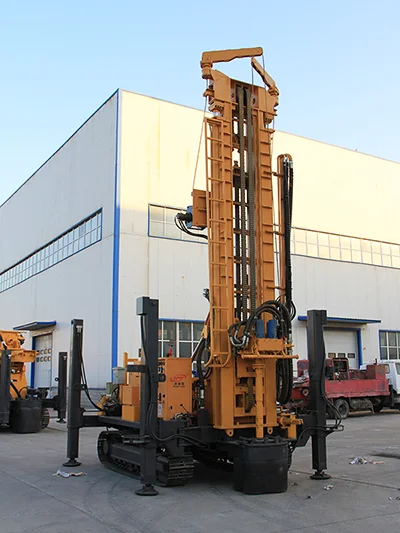


600 Series Water Well Drilling Rig
Well drilling equipment for drilling depths up to 650m with a borehole diameter range of 105-450mmIdeal for loose formations and bedrock, the water well drilling rig operates rotary drilling and feed system, supporting both hammer drilling and mud drilling.
The drilling diameter range is 105 to 450 mm, with a maximum depth of 600 or 650 m.
The operating air pressure is 1.6 to 6 MPa, and the air consumption is 16 to 75 m³ per minute.
The drilling efficiency is 10 to 35 m per hour.
The water well drilling rig provides stable power output, high speed and optional components such as mud pump and generator.
Technical Parameters
| Parameter | Unit | ||
| Max. drilling depth | m | 600 | 650 |
| Drilling diameter | mm | 105-450 | 105-450 |
| Recommended air pressure | MPa | 1.6-6 | 1.6-6 |
| Recommended air consumption | m³/min | 16-75 | 16-75 |
| Drill pipe length | m | 6 | 6 |
| Recommended drill pipe diameter | mm | 102 | 102 |
| Axial pressure | t | 6 | 6 |
| Lifting force | t | 38 | 38 |
| Fast lifting speed | m/min | 30 | 30 |
| Fast feeding speed | m/min | 62 | 62 |
| Max. rotary torque | N·m | 11000/5500 or 13000/6500 | 12000/6000 or 14000/7000 |
| Max. rotary speed | r/min | 105/210 | 105/210 |
| Small auxiliary winch lifting force | t | 2.5 | 2.5 |
| Jack stroke | m | 1.6 | 1.6 |
| Drilling efficiency | m/h | 10-35 | 10-35 |
| Traveling speed | km/h | 4.5 | 4.5 |
| Gradeability | ° | 21° | 21° |
| Rig weight | t | 13.5 | 13.5 |
| Overall dimensions (L x W x H) | m | 6.3x2.25x2.65 | 6.3x2.25x2.65 |
| Working conditions | Unconsolidated formations and bedrock | ||
| Drilling method | Top drive hydraulic rotary and feed; DTH hammer or mud drilling | ||
| Matched DTH hammer | Medium- and high-pressure series | ||
| Optional accessories | Mud pump, centrifugal pump, generator, foam pump | ||