
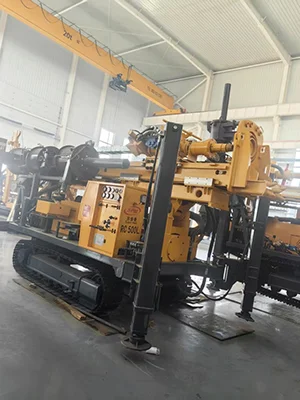
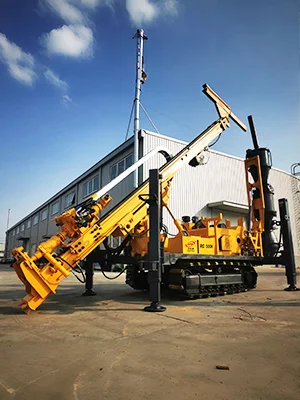
RC500L Reverse Circulation Drilling Rig
RC drill rigs for drilling depths up to 400m with 105-400mm hole diameters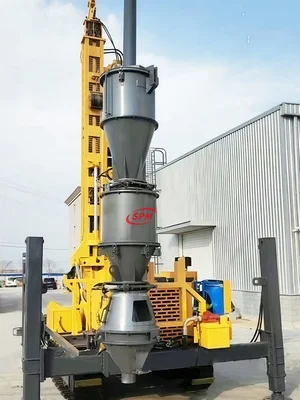
Technical Parameters
Basic Parameters
| Parameter | Specifications |
| Product model | RC500L |
| Working air pressure and air volume | Pressure: 1.2-3.5MPa; Air volume: 16-55m³/min (DTH hammer drilling) |
| Rock hardness | F4-F22 |
| Drill hole diameter, mm | ⌀105-⌀400 |
| Drilling depth, m | 400 |
| Drill pipe length, m | 3 |
| Drill pipe diameter, mm | ⌀102/⌀114 |
| Drilling angle, ° | 45-90 |
| Max. propulsion force, kN | 70 |
| Max. lifting force, kN | 250 |
| Power head torque, N·m | 10000/5000 |
| Rotary speed, rpm | 0-75 (adjustable) / 0-150 (adjustable) |
| Traveling type | Tracked |
| Machine noise, dB | 85-90 |
| Transmission mode | Hydraulically driven |
| Equipped DTH hammer | RC45 / RC55 / SPM |
| Overall dimensions (L x W x H), mm | 7000x2100x2800 (subject to design) |
| Weight, kg | Approx. 12000 (subject to design) |
Component Parameters
| Power head | Manufacturer | SPM |
| Max. output torque, N·m | 10000 | |
| Output speed (continuous operation), rpm | 0-75 (adjustable) / 0-150 (adjustable) | |
| Rotary acceleration output speed (intermittent operation), rpm | 150 | |
| Max. lifting force, kN | 250 | |
| Max. propulsion force, kN | 70 | |
| Engine | Product model | 6BTA5.9-C180 |
| Manufacturer | Cummins | |
| Power, kW | 132 | |
| Rated speed, r/min | 2200 | |
| Cooling method | Water cooling | |
| Displacement, L | 5.9 | |
| Fuel tank volume, L | 140 | |
| Oil pump | Model | 1123733843 |
| Manufacturer | PERMCO | |
| Oil pump displacement, L/min | 113+113+43 at 1800rpm | |
| Max. pressure, MPa | 21+21+26 | |
| Hydraulic oil tank volume, L | 240 | |
| Max. operating temperature, °C | 75 | |
| Auxiliary winch | Single-rope lifting force, kN | 15 |
| Wire rope diameter, mm | Ø11 | |
| Wire rope length, m | 60 | |
| Chassis | Traveling speed, km/h | 2.5 |
| Gradeability, ° | 21 | |
| Mast | Drilling angle, ° | 45-90 |
| Feed stroke, mm | 4100 | |
| Mast sliding stroke, mm | 1500 |