
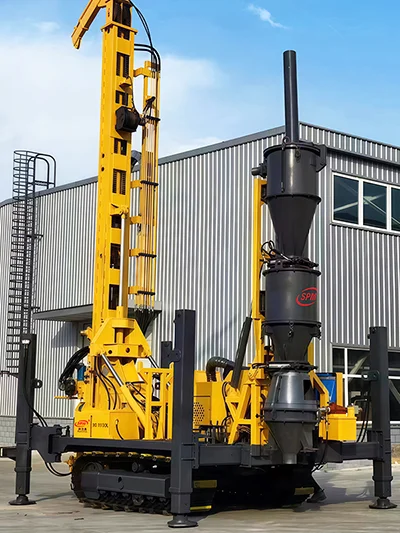


RC1200L Reverse Circulation Drilling Rig
RC drill rigs for drilling depths up to 1000m with 105-800mm hole diametersThe reverse circulation drilling rig offers a maximum drilling depth of 1000 m and is suitable for a wide range of formations from F4 to F22.
It can be equipped with a high-power engine and an high-torque power head (24,000 N•m).
The rig features a hydraulically driven crawler chassis, a reverse-circulation DTH hammer, and powerful feed and lifting capacities.
It supports deep-hole and long-distance drilling in hard rock formations, ensuring stable, durable performance and easy maintenance.
Ideal for engineering exploration and large-scale mining operations.
Technical Parameters
Basic Parameters
| Parameter | Specifications |
| Product model | RC1200L |
| Working air pressure and air volume | Pressure: 1.6-8MPa; Air volume: 16-96m³/min (DTH hammer drilling) |
| Rock hardness | F4-F22 |
| Drill hole diameter, mm | Ø105-Ø800 |
| Drilling depth, m | 1000 |
| Drill pipe length, m | 6 |
| Drill pipe diameter, mm | Ø127/Ø146 |
| Drilling angle, ° | 45°-90° |
| Max. propulsion force, kN | 130 |
| Max. lifting force, kN | 570 |
| Power head torque, N·m | 24000/12000 |
| Rotary speed, rpm | 0-86 (adjustable) / 0-172 (adjustable) |
| Traveling type | Tracked |
| Machine noise, dB | 85-90 |
| Transmission mode | Hydraulically driven |
| Equipped DTH hammer | RC45-RC160/SPM |
| Overall dimensions (L x W x H), mm | 11500x2250x3400 (subject to design) |
| Weight, kg | Approx. 23000 (subject to design) |
Component Parameters
| Power head | Manufacturer | SPM |
| Max. output torque, N·m | 24000 | |
| Output speed (continuous operation), rpm | 0-86 (adjustable) / 0-172 (adjustable) | |
| Rotary acceleration output speed (intermittent operation), rpm | 172 | |
| Max. lifting force, kN | 570 | |
| Max. propulsion force, kN | 130 | |
| Engine | Product model | Weichai 220 / Cummins 360 |
| Power, kW | 220kW / 264kW | |
| Rated speed, r/min | 2200 | |
| Cooling method | Water cooling | |
| Displacement, L | 8.9 | |
| Fuel tank volume, L | 200 | |
| Oil pump | Model | L8VO140 |
| Manufacturer | AVIC Liyuan | |
| Oil pump displacement, L/min | 252+252 at 1800rpm | |
| Max. pressure, MPa | 30+30 | |
| Hydraulic oil tank volume, L | 450 | |
| Max. operating temperature, °C | 75 | |
| Auxiliary winch | Single-rope lifting force, kN | 25 |
| Wire rope diameter, mm | Ø11 | |
| Wire rope length, m | 60 | |
| Chassis | Traveling speed, km/h | 6.4 |
| Gradeability, ° | 21 | |
| Mast | Drilling angle, ° | 45-90 |
| Feed stroke, mm | 7000 | |
| Mast sliding stroke, mm | 1900 |